
1. Ecommerce websites in Vietnam remain a key part of the digital ecosystem
In Vietnam, websites are not considered as the main sales channel for many businesses. Many purchases still happen offline or through ecommerce marketplaces such as Shopee or TikTok Shop rather than directly on brand websites.However, this does not mean ecommerce websites are less important. Their importance comes from the fact that websites act as a centralized information hub where customers can learn about products, compare options, and evaluate brand credibility before making a purchase decision. Even when the final transaction does not happen directly on the website, it still strongly influences customer trust and buying behavior.
A well-structured ecommerce website helps businesses present their products professionally, improve search visibility, support marketing campaigns, and create a more reliable customer journey. This is why ecommerce website development should not only focus on visual design, but also on user experience, website SEO, mobile usability, and conversion optimization.

2. Common issues that reduce ecommerce website performance
Many ecommerce websites fail to convert not because the products are weak, but because the website experience creates too much friction. Customers may already have purchase intent, but if the website is slow, unclear, or difficult to use, they may leave before taking action.
Below are some of the most common issues businesses should pay attention to.
2.1 Slow website loading speed
Website speed is one of the biggest factors affecting ecommerce conversion today. Customers expect ecommerce websites to load quickly because online shopping behavior is highly convenience-driven. When users click on products from TikTok, Facebook Ads, Google search, or influencer content, they usually want immediate access to product information. However, many ecommerce websites still load slowly because of oversized images, heavy homepage banners, unoptimized code, or weak hosting infrastructure. As a result, pages take too long to display, scrolling becomes laggy, and product images appear slowly. Instead of waiting, many users leave before interacting with products or reaching checkout pages.
Website speed affects more than usability. It also influences how customers perceive the brand itself. If the website feels outdated or unreliable, users may question product quality, payment security, or delivery reliability. This becomes especially important for ecommerce brands competing against marketplaces that already provide smooth shopping experiences. Website speed also affects website SEO because search engines prioritize websites with better page experience and mobile usability.
2.2 Poor product content quality
One of the most common issues in ecommerce websites is unclear or incomplete product information. Many product pages do not provide enough detail for users to fully understand what they are buying. In many cases, product descriptions are too short, lack structure, or fail to explain key information such as features, benefits, usage, or specifications. Images may also be limited or not descriptive enough, making it difficult for customers to visualize the product in real use. When product content is not clear, users are forced to spend more time searching for information or leave the website to compare with other sources. This creates friction in the decision-making process and reduces the likelihood of conversion, even if the product itself is relevant to their needs.
2.3 Lack of responsive design for mobiles and tablets
Mobile devices now account for the majority of ecommerce traffic in Vietnam. Users often discover products while browsing TikTok, Facebook, Instagram, or watching livestreams, and then switch to ecommerce websites to verify key information before making a purchase. In many cases, they already have purchase intent and simply need to check product details, pricing, delivery options, promotions, or customer reviews. Because of this behavior, mobile usability has become a critical factor influencing ecommerce conversion rates. If the mobile experience is slow, difficult to navigate, or not optimized for small screens, users are likely to abandon the website and continue their purchase journey on other platforms or marketplaces.
However, many ecommerce websites are still primarily designed for desktop instead of mobile-first usage. Common issues include complex navigation menus, unreadable small text, oversized images or banners, slow-loading pages, and checkout forms that are not optimized for mobile input. These usability issues create friction throughout the customer journey. Even when users already show strong purchase intent, a poor mobile experience can quickly reduce engagement and lead to drop-offs, ultimately lowering overall conversion performance.
2.4 Complex menu and unclear CTA
Many ecommerce websites have overly complex navigation structures and unclear call-to-action (CTA) elements, which make it difficult for users to move smoothly through the buying journey. When menus contain too many categories or are not logically organized, users can struggle to quickly find the products they are looking for. This increases frustration and often leads to early drop-off, especially for first-time visitors. At the same time, unclear or poorly designed CTA buttons such as “Buy now,” “Add to cart,” or “Contact us” reduce user guidance. If users are not immediately sure what action to take next, they are more likely to hesitate or leave the website. Overall, complex navigation combined with weak CTA clarity creates unnecessary friction in the user experience and directly impacts conversion rates, even when product interest is already high.

3. How WebaseGroup supports ecommerce website development
Building a high-converting ecommerce website requires more than visual design. Businesses also need websites that support customer behavior, mobile usability, SEO performance, and long-term scalability. At WebaseGroup, website development focuses not only on creating professional interfaces, but also on improving how customers browse products, evaluate information, and complete purchases online.
WebaseGroup supports businesses in building ecommerce websites with responsive design, SEO-friendly structure, optimized user experience, and scalable performance across desktop and mobile devices. By combining website development, user interface user experience optimization, and website SEO strategy, businesses can create ecommerce websites that not only attract traffic but also support stronger conversion performance and long-term sales growth.
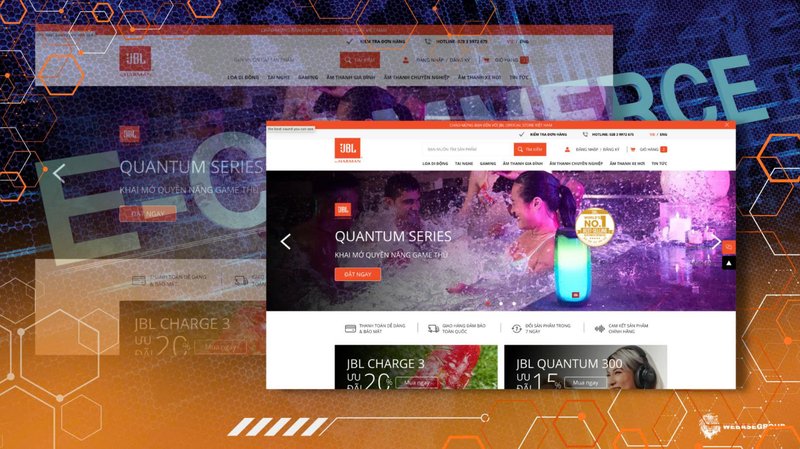
A clear example can be seen in campaign microsite projects developed by WebaseGroup, such as the the JBL campaign microsite. These ecommerce websites were designed with a strong focus on user journey optimization, ensuring that users can quickly understand key messages, easily navigate product information, and interact smoothly across different devices.
- JBL campaign microsite: https://portfolio.webasegroup.com/jbl
Through these implementations, WebaseGroup demonstrates how a well-structured and user-centric ecommerce website can significantly improve engagement and support better conversion performance in ecommerce and campaign-driven environments
4. Conclusion
Ecommerce website development in Vietnam plays a much larger role than simply displaying products online. They directly influence customer trust, browsing behavior, conversion rates, and long-term sales performance. As ecommerce competition becomes increasingly mobile-first and convenience-driven, businesses need websites that support fast browsing, clear product information, smooth checkout experiences, and strong SEO performance. Website development is no longer only about creating visually attractive ecommerce websites. Businesses also need to focus on user interface user experience, website SEO, and conversion-focused optimization to help traffic turn into real customers and sales.